
Different seasons, different experiences
Tanzania has no single best travel month. Calving in the southern Serengeti, northern river crossings, dry-season wildlife, western forest trekking and Kilimanjaro climbing follow different patterns. Rainfall, vegetation, visibility, animal movement, trails and access matter more than a nationwide season label.
Wildlife and safari seasons
January–February — calving and green plains
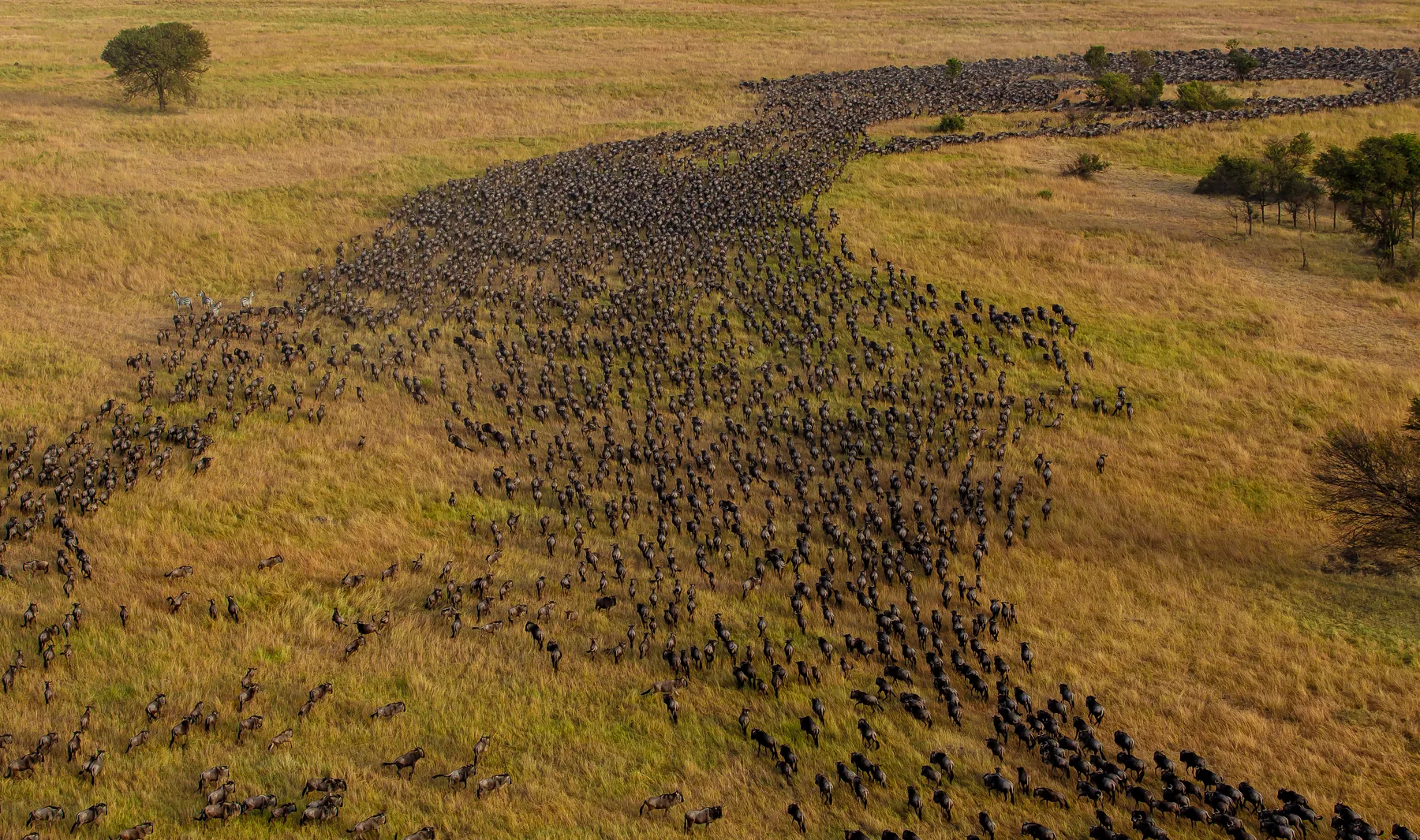
The Ndutu and southern Serengeti–Ngorongoro grasslands are strongly associated with wildebeest calving during this period. Newly born animals can attract predators, and the open landscape offers a different ecology from the northern dry-season migration.
Rainfall and vegetation affect timing and herd concentrations. No particular birth, hunt or herd size is assured.
Other parks can be green and rewarding at the same time, with seasonal birds, lush vegetation and changes in habitat visibility. Fewer visitors may be possible in some locations, but this is not universal.
March–April — rain and access
Rains can transform colour, birdlife and vegetation, while also making unpaved roads, forest paths and some remote access routes difficult. The migration's pattern may spread across the southern and central ecosystem depending on rainfall.
The decision is not simply 'avoid the rains.' Consider the particular park, accommodation, vehicle access and activity. A beautiful landscape may coincide with more uncertain logistics.
May–July — western movement
The Serengeti migration often progresses toward the western corridor and Grumeti region as grazing patterns change. Elsewhere, improving dry-season conditions can shape visibility and access. June and July can feel relatively cool, particularly at altitude or during early mornings.
River crossings depend on the animals and conditions at the time. In some parks, lingering rains also affect track conditions and access.
July–October — drier landscapes
Dry-season conditions often encourage wildlife concentrations around lasting water sources in Tarangire, Ruaha, Katavi and other landscapes. The northern Serengeti is associated with potential Mara River crossings during a broad period often marketed as July–October, with variation extending beyond these months.
Large herds may be seen without a crossing, or may be dispersed. Crossings are especially unpredictable.
November–December — returning rains
Short rains can bring fresh grass and changing movements across the Serengeti. Toward the end of the year, the southern plains may become increasingly important again. Landscapes often shift quickly; calendar labels are much less precise than rainfall and recent field observations.
For a traveller, the transition is an opportunity to consider different habitats, not a guarantee that the migration has reached one particular location.
Explore wildlife and the Great Migration.
Following the Serengeti migration
| Broad period | Area commonly associated with movement | What to understand |
|---|---|---|
| December–April | Southern Serengeti, Ndutu and adjoining Ngorongoro areas | Grazing and calving conditions vary with rainfall |
| May–July | Western corridor and Grumeti | Movement and possible crossings are not scheduled |
| July–November | Northern Serengeti and the Mara River region | Herd presence and crossings remain highly variable |
| Transitional months | Central and wider ecosystem | Movement can be dispersed and does not follow neat regional borders |
The year-round migration shifts with grazing and rainfall. Use broad months to choose a region, then check recent local conditions rather than treating the calendar as a forecast.
Chimpanzee trekking seasons
Mahale and Gombe are often recommended during the relatively drier months, broadly around June–October, when some forest paths may be easier to negotiate. The distribution of fruit and chimpanzee groups changes seasonally; in Mahale the animals may be found higher on the mountain slopes during parts of the year.
A harder trek does not necessarily mean a worse forest experience, but physical effort, humidity and the chance of finding the chimpanzees need to be understood.
The wet season can offer rich forest scenery and fewer visitors in some periods, but rain, trail condition and transport constraints may be significant. In both parks, limits on visitor groups and viewing time apply throughout the year.
Mountain weather and climbing
Many climbers look first at January, February or September because of their generally more favourable mountain-weather patterns. Other periods can also be rewarding, with meaningful differences in temperature, rain and visibility:
- Mid-December to mid-March: a generally warmer lower-mountain period, not a warm summit.
- June–July: cooler conditions and potentially crisp walking weather.
- August to mid-October: often described as drier, with opportunities for good visibility.
- June–October for Mount Meru: a commonly favoured period for comparatively dry trails.
These are broad patterns. Weather at 5,000 metres differs sharply from Moshi or Arusha; clear lower slopes do not imply a safe, snow-free summit. Route choice, acclimatisation, experience and guide decisions matter year-round.
Explore climbing routes and preparation.
Seasonality also shapes other experiences
Forest and waterfall walks. Flow, mud, slippery ground and trail accessibility can change with rainfall. A fuller waterfall is not always an easier or safer visit.
Birdwatching. Water conditions, seasonal breeding and habitat changes affect what may be seen in lakes, wetlands, forests and savannah.
Boating and lake experiences. Wind, water levels, navigation and the availability of an authorised vessel matter. A season described as favourable for wildlife does not establish safe boating on a particular day.
Culture and museums. Cultural experiences are not reducible to wet and dry seasons. Opening days, host availability, local events, religious observances, site conservation and individual permissions may matter more.
Remote western areas. Access to places such as Katavi, Mahale and Ugalla can be materially affected by weather, roads and specialised transport. Confirm the real route rather than assuming a map shows a usable connection.
Compare seasons by interest
| Your interest | Season to investigate first | What remains uncertain |
|---|---|---|
| Wildebeest calving and southern plains | January–February, with surrounding months considered | Location, onset and concentration of calving |
| Northern Serengeti and Mara River | Broadly July–October; sometimes later | The timing and location of an actual crossing |
| Dry-season wildlife concentrations | Often June–October; region varies | Water conditions, animal distribution and accessibility |
| Chimpanzee trekking | Often June–October | Trail demands, chimp location, permits and transfers |
| Kilimanjaro climbing | January–February and parts of August–October/September | Weather, altitude, route and operator support |
| Mount Meru ascent | Often June–October | Park/ranger permissions and actual trail conditions |
| Green landscapes, birding and varied vegetation | Rainy and transitional months, by region | Access, visibility and rainfall |
| Urban culture, museums and archaeological places | Potentially year-round | Opening times, permissions, guides and transport |
Use the months as starting points; local conditions and the activity determine suitability.
Seasons beyond the safari
Eastern Arc forests. The Uluguru, Usambara and Udzungwa landscapes have local rainfall patterns and forest microclimates. Drier windows can make some walks easier, but forest trails may remain wet, and birding or botanical interests can favour different conditions. Endemic wildlife can be hard to observe at any time without specialist knowledge.
Ngorongoro Highlands. A drive through the crater, an Empakaai walk and a strenuous Lengai ascent are exposed to very different terrain and weather risks. The broad safari season is not an adequate climbing-weather decision rule.
Swahili Coast and islands. Marine activity depends on winds, currents, sea conditions, tides and the seasonality of local operators. A month favourable for inland wildlife need not be suitable for a particular boat crossing, dive or snorkelling excursion.
Great Lakes. Lake wind and waves, shoreline conditions, road access and ferry or boat operations matter. Seasonal vegetation and accessibility can also shape western wildlife experiences such as Katavi and Ugalla.
Historic and cultural places. Museums, markets and cultural events follow human calendars as well as the weather. Opening times, local observances and community arrangements may matter more than choosing a dry month.
Explore the Eastern Arc, Ngorongoro Highlands, Swahili Coast and Great Lakes.
Fees and other costs
A visitor's official protected-area fees can depend on nationality or residence category, age, destination, date, activity, number of days and applicable rules. Some fees are per person, some per vehicle, some per occurrence and some relate to accommodation or essential services.
Accommodation, transport and guide services are additional costs to consider. Knowing the official charges is useful, even when the rest of the journey has yet to be arranged.
KAONE's tools help you separate official protected-area charges from the wider cost of travel:
Browse fees
Browse fees to inspect published protected-area and activity charges and their relevant applicability. Source evidence and coverage may vary.
Calculate fees
Calculate fees to determine supported official liabilities for the visitor categories, protected-area days, destinations and activities you supply. A result can be Complete, Partial or Blocked depending on the available facts and unresolved conditions. It is not an accommodation, food, guide, transport or total package quotation.
Trip scheduling
Trip scheduling to see how supported protected-area experiences might fit within your selected arrival date and days. The scheduler uses activity and location constraints but does not confirm a commercial booking, inter-destination route or real-time wildlife activity.
A proposed schedule can lead into Calculate Fees, where your visitor details and selected activities are used to work out supported official charges.
Before committing to dates
Before booking, distinguish five questions:
- Seasonal suitability: Is this a broadly promising time for the kind of experience sought?
- Regulatory permission: Is the activity permitted in the precise protected area?
- Physical and practical feasibility: Can you undertake it with your available time, health and access?
- Commercial availability: Is there an actual operator, guide, place or transport connection for your dates?
- Cost clarity: Which official charges are known, and which other expenses remain outside KAONE's calculation?
Seasonal information and park rules can narrow your choice. A provider can then establish which services and connections are available on your actual dates.